00:00:14:10 - 00:08:38:20
Unknown
Like a.
00:08:38:22 - 00:08:50:07
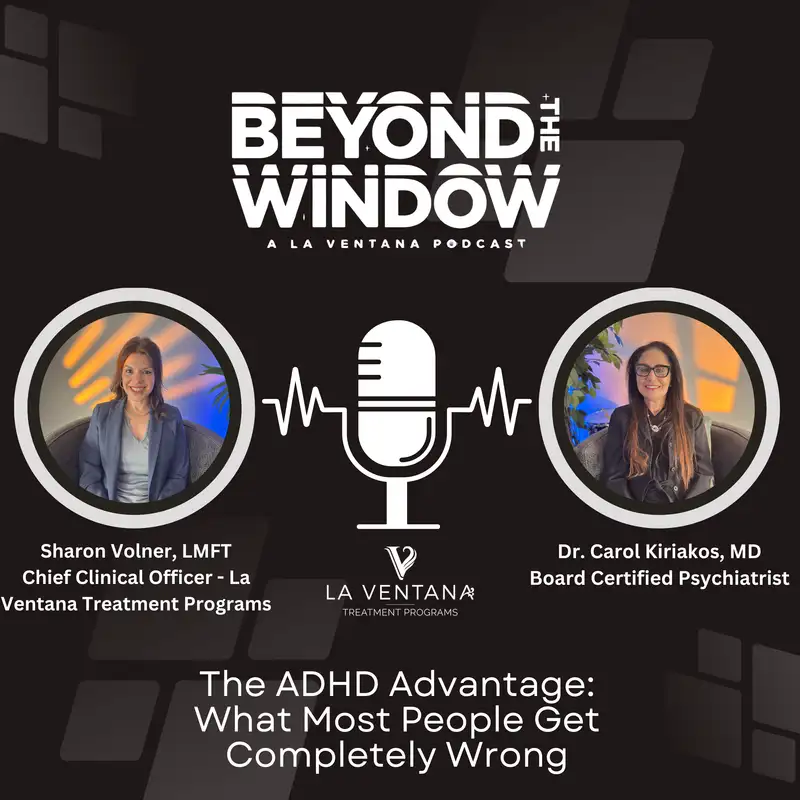
Thank you for joining us on another episode of Beyond the Window podcast. I'm Sharon Volner, LMFT and chief clinical officer at La Ventana Treatment Programs. Today I'm especially excited about our guest.
00:08:50:07 - 00:09:16:23
We have the one and only doctor, Carol Kiriakos, psychiatrist in the house, and she's here to talk about her field and her wonderful book called the ADHD advantage A Comprehensive Guide from Childhood to Adulthood. And we'll talk more about this book. We lovingly call her doctor K. So welcome, doctor K. Thank you. What did I not share? Gosh, there's so much board certified psychiatrist.
00:09:16:23 - 00:10:06:01
Tell us more. I also work in addiction. I work with eating disorders. I work with PTSD patients. I also see adolescents as well as adults, you know, and let's see, I had been with Lauv and Tana since spring, about May of 2015 that we just determined before we started this. Yes. And it's been wonderful, just all these variances of working with different types of patients here from an addiction primarily, but at some point eating disorders and then residential mental health, all levels of care, residential free IOP, just seeing patients through the entire process.
00:10:06:03 - 00:10:27:12
And I knew that our patients really enjoy working with you. You have amazing chair side manner and just a very relatable approach of, you know, you're not you know, I think sometimes we get this idea in our head when we're talking to a doctor or a psychiatrist, they're they're going to be in a white jacket and they're going to be very firm, and they're going to just rush through the orders.
00:10:27:12 - 00:10:51:10
And and we're not going to understand that you have this beautiful approach of just having a conversation with another human being about what's needed to for the next step in their journey. And I've known you for a long time, but for our viewers and listeners, tell us more about the idea behind the book. Where did it come from?
00:10:51:12 - 00:11:22:05
Thank you for this opportunity. First of all, so this came from a lot of different sources. I got a call from a wonderful meeting and Ariel Wilcox, it was March, April of 2025, and she basically was looking for a psychiatrist to help write a book on ADHD. At first it was a book on adults with ADHD.
00:11:22:07 - 00:11:58:12
But more from a non medication standpoint in terms of sort of the psychology and biology of how they present and, looking at it more, I sort of put the spin on it of looking at it more as a gift and an asset rather than as a disability, whereas something that was a handicap or a hindrance basically based on honestly, a lot of the patients that I work with at La Ventana and have worked with at the La Ventana have worked with in my private practice.
00:11:58:12 - 00:12:37:18
Other facilities I've worked at, because they have a lot to offer and a lot of, do really well in life. And I noticed certain patterns, so I wanted to highlight it more as a gift rather than a disability. And to do that, I really needed to expand and go deep into what that looks like and how people can take away from some of the gifts that come with it, rather than looking at everything as a crutch or as, okay, I need a pill for this, I need services for that.
00:12:37:20 - 00:13:02:23
But just how to roll with it and use it to their benefit. And ADHD comes with such a stigma. Yeah. So for me as a parent, as a person on this field, I hear parents all the time or people in general talk about ADHD. It just gets thrown around. Anyone with hyperactivity or inattentiveness, they fall into that category.
00:13:02:23 - 00:13:24:23
But it's so much more. And I've even heard you refer to it as a superpower. Can you share more about what is ADHD? What does it look like because it doesn't look the same and everybody know? That's a great question. It definitely looks different and different people, the same way that depression or bipolar disorder would. And it's it's not an IQ issue at all.
00:13:24:23 - 00:13:58:14
In fact, most people with ADHD tend to have very high IQ. But it is an attentional challenge. So people have a hard time sometimes following a train of thought. If there's something that they're just not excited about, or something that feels boring or bland or something that's difficult for them, but too challenging. And what also happens is they might be into something, and then train of thought goes and 5 or 10 different other places.
00:13:58:14 - 00:14:26:22
Oh, this reminds me at the time that I did this or oh, did I turn off the stove or oh wait, I forgot to put this in the fridge or, God, call so-and-so. So you just have a running train. All kinds of different ideas and thoughts going through your brain as you're tackling one task. Sometimes that can work in your favor if you're brainstorming on ideas for something, and then other times it gets kind of difficult.
00:14:27:00 - 00:14:52:12
What I noticed with a lot of people with ADHD and studies show this too, is one of their superpowers, is their ability to hyperfocus. And what I mean by that is if they have a deadline, that's usually when the fire gets under them and they really push it and are able to perform and perform really well and above and beyond what most people without babies shall be able to do.
00:14:52:14 - 00:15:20:23
It's kind of like they need the challenge, they need the something under them, the drive, the adrenaline and the dopamine to make it happen. So if you get someone with ADHD a task and you give them six months to finish it, 80% of them will do it in the last like 2 to 4 weeks. And they will do it well and better than, you know, other people who would have started on day one.
00:15:21:01 - 00:15:52:18
And there's something about their laser focus that also combines with dopamine that just helps get the job, John, and solidify the change. And the project comes out and they're the movers and shakers. They're the creatives. They're the people who don't do well in 9 to 5 jobs. They're usually the self-starters who come up with their own invention, their own business, their own model, and they just do really well and diverse settings.
00:15:52:20 - 00:16:29:00
And then how does it fluctuate or change and expand from childhood to adulthood? That's also a great question. So in the childhood years, it's sometimes difficult to rein in because there are different types of ADHD, as you know, there's sort of, hyperactive type. Those are the people that tend to be the class clowns, the people that bought things, you know, out without raising their hand the loudest person in the room, person who always needs to have a last word, make noise.
00:16:29:02 - 00:16:57:14
And then there's the daydreamer type who just sits there while there are lectures going on or teachings going on. And, you know, you can ask them what was being talked about, and they have no idea because their mind was telling on something else. And then you have the combine type, which is a little bit of both. And when when people were young, like kids, kids in general, the younger they are, have a lot harder time with self-control.
00:16:57:16 - 00:17:31:00
So they have a harder time bringing in a lot of their physiological like hyperactivity and shaking or talking out of turn or blurting things out literally. I've seen so many ADHD kids just can't sit still in their seat, move around like 20 different times in five minutes, or they're shaking their leg or chewing or pencil. But then as you get older, you're able to rein that step in more, and it's more, people on the outside don't notice it as much.
00:17:31:02 - 00:17:55:14
They're the kids who did well in school, for example, but they had to study five times harder than everybody else, or read the same chapter over and over again just to retain the information. You still get the good grade, but it was a lot harder for them to get there. They're not, the attention getters in the class, so they often fall under the radar.
00:17:55:16 - 00:18:25:09
And then where they get stuck in later adulthood is, they achieve a lot, but then standardized tests come into play and then they tend not to perform, to the best of their abilities. Like straight-A student gets average SAT scores or like barely passing SAT scores, which doesn't really make sense. But you know, something happens when they're sitting there taking a time test.
00:18:25:10 - 00:18:51:20
Their brain goes all over the place. They start talking themselves into what the right answer is, and they overthink and they all reanalyze and, they doubt themselves often and they just have a hard time making decisions. And over time, people's self-esteem kind of goes low, too, because they're working so hard just to get by or succeed. And to other people, you know, it doesn't seem that hard.
00:18:51:22 - 00:19:20:04
And they start to wonder what's wrong with me and things like that. And, as we get older, it just shows up more and certain decisions we make, who we marry, who we date, what we do for our career choices, how we handle situations. But for people with untreated or unrecognized ADHD, there tends to be a low level, low self-esteem issue that happens.
00:19:20:06 - 00:19:45:22
They feel like, okay, people tell me I'm smart, but I don't really feel some immense. I. And for a while, the people that we see here like are meth addicts or cocaine addicts, you know, they turn to drugs and substances to self-medicate, to help them calm down. So the irony is that stimulants and people without ADHD would make them look like they have ADHD.
00:19:46:00 - 00:20:13:01
They can be hyper and all over the place, but people that actually have ADHD, that drink coffee or take stimulants, it actually helps them fall asleep or just calling their brain down so they can focus. And then you hear about onset. So this all adolescent or childhood ADHD develop into adult ADHD can fizzle out. Can someone midlife have an onset of ADHD.
00:20:13:03 - 00:20:43:10
That's a great question. So what really happens is if you take a good history, like an adult can come into my office, they're in their 40s and they realize, wow, I'm married, I have kids, my wife is doing a lot, I have my own business and I just can't handle running everything. I'm getting flustered. I need help, and when you take a childhood history, these are the kids that were the class clowns that had a hard time.
00:20:43:10 - 00:21:09:19
Some of them maybe had to repeat a year of school or have tutoring to compensate. Were they compensated by being OCD, which is something that a lot of people with ADHD do, like they make compulsive wash, or they keep thinking about something in their head over and over so they don't forget. So, people have different compensatory mechanisms, but then then you hit a breaking point, and that's when they usually seek professional help, when they just can't keep up.
00:21:09:21 - 00:21:35:00
Right. Like they're having to take the board exam over and over again, or they're not succeeding at their job. That has strict time limits, or they're not showing up for work on time, or they're just not getting things done with the same level of productivity as others are, or they're just getting too flustered and overwhelmed. So then they come in and people say, oh, you have adult ADHD.
00:21:35:02 - 00:21:55:02
The truth is, you've had ADHD all your life. But it's now becoming apparent because it's now stopping. You were able to compensate all this time, and then you reach a point where you just can't keep up anymore. You often see it also with kids, linear from middle school to high school, and all of a sudden the workload is a lot more.
00:21:55:03 - 00:22:18:12
They don't have time to read something 5 or 6 times over, or when they go to college or grad school, they just can't keep up with the pace of learning. And so, they were able to compensate up and to a certain point. So the true belief is that people who have ADHD have a deficit that's been there all along.
00:22:18:14 - 00:22:46:16
Some people are able to ride the wave and get through and do well, but it just takes more and more effort. And other people, and they do it all up. And to a certain point, some people, there's certain point is childhood, others it's adulthood, adolescence and so forth. So the truth is it is something that you're born with, but it might not become problematic until certain set points in your life.
00:22:46:18 - 00:23:19:09
And for children, will it is it something with early intervention that could be managed and treated and gone? Sometimes I would say manage. Okay, I don't know that you could really say gone, but the example I like to use is someone who's diabetic, from childhood. If they are taking their right amount of insulin, they're checking their blood sugar, they're eating correctly, they can have normal blood sugars for their entire life.
00:23:19:10 - 00:23:44:23
Are they still diabetic? Yes. Is it problematic? No. But if you stop all the meds and don't do what you're doing to manage, you know, you can fall right back into a diabetic crisis. With ADHD, it's a tiny bit different because people do learn behavioral ways to cope. And let sort of the time where your brain just goes free kind of work for you.
00:23:45:01 - 00:24:11:11
So it's more about timing of controlled attention to get through. But if you don't follow that and you just kind of let it go, then you always are going to have ADHD. But then your ADHD is in control and you can manage life normally in the way that you want to. If it's not in control and you're not doing anything to help, it then becomes a problem.
00:24:11:13 - 00:24:36:02
And what are interventions to manage ADHD? In my book, I talk a lot about different ways to manage ADHD. It's interesting because a lot of people like educators, parents assume that kid needs to be in a room all by themselves. It needs to be quiet. They can't have any distractions, or they're not going to be able to do that work.
00:24:36:04 - 00:25:13:21
The irony is you need a little bit of distraction to kind of get out of all the other thoughts in your head so that you can focus on the task at hand. And this could be anything, not just school. It can be you're doing construction, you're cooking whatever it is that you're doing in life. But sometimes just having white noise in the background or listening to music that you consider calming or being in a coffeehouse doing your work can actually help you stay focused, because then all those thoughts that would otherwise interfere are gone by the outside noise and white noise.
00:25:13:21 - 00:25:35:05
You know, obviously you could do this in a concert or something like that, like, you know, something like, auditorium or a room where people would study. Sometimes people study side by side and that helps them stay focused. Otherwise their mind would be like, oh, I'm going to go to the fridge. I'm in the kitchen. My bad. I'm going to go take a shower or, you know, like just being away from distractions helps.
00:25:35:07 - 00:26:08:18
But having a little bit of distraction can help you stay on task. So that's a big one because most people think like quiet room, no noise, need a little bit, and then sometimes doing things when your mind is most sharp. So if you're a morning person trying to do a, more difficult, difficult tasks that require more thought, like reading or assignments or big things like that you dread doing, or things that you know are going to take a lot of focus.
00:26:08:20 - 00:26:38:15
If you're a night person or a night owl, then maybe your productive time starts after six, you know? So kind of working with your biologic circadian rhythm and your biological clock is helpful. This and back to the stigma, because there's also a lot of myths about ADHD that it's the constantly hyper kid. It's mostly boys. Kids are not as intelligent.
00:26:38:17 - 00:26:59:20
It was bothers me to hear the meds, but I want to hear it from a doctor. How do we destigmatize and what is the facts about so ADHD has nothing at all to do with intelligence. It has everything to do with attention and focus. Most of the people that I see with ADHD are the smartest people I've ever met, because they can think outside the box.
00:26:59:20 - 00:27:26:20
They're very creative, they're very entrepreneurial. They don't like ordinary common things. They like things that are unique and exciting. So they're not afraid to try new things. They're not afraid to challenge themselves. That's what drives them to get things done. So, a lot of the people that I see with ADHD are also on the spectrum, which is interesting because a lot of people on the spectrum also have very high intelligence.
00:27:26:22 - 00:28:01:08
So there seems to be some link with neurodiversity between ADHD and certain other, you know, disorders, like the on the spectrum or anxiety to look for OCD. A lot of times I see people with severe OCD and then realize later, oh, they're compensating for their ADHD. And I find out because when they're on a particular medication or when they're doing things differently to get tasks done, all of a sudden the OCD goes away without even treating that OCD.
00:28:01:10 - 00:28:31:21
So interface in different ways. You also asked about boys versus girls. So traditionally and commonly ways when they're young tend to be more hyperactive, which is true anyways. Whether you have ADHD or not. This is a mom of two kids and then and girls can too, but girls tend to manifest it more, as being the daydreamer, so they're not the ones that will disrupt a whole roomful of people.
00:28:31:21 - 00:28:51:16
They're the ones that will be kind of out on the sidelines, like thinking about 12 other things while someone's trying to have a conversation with them. So kind of like the out to lunch kid. But the truth is, girls can also be hyperactive, and boys can also be inattentive that you tend to see it more commonly early on.
00:28:51:20 - 00:29:17:10
The boys are more hyperactive, girls are more inattentive. And then usually when people get to their like adolescence, later adolescence, like high school and beyond, a lot of the hyperactivity kind of dies down, which I think is more a function of maturity and growth and different neurons forming in your brain. And connections and just learning to deal with the world socially.
00:29:17:12 - 00:29:42:07
So people are able to hide certain aspects of working things out, like trying to count to ten or, you know, distracting their thoughts or waiting their turn. They're just more able to do that because they're more mature and they're more socially aware. And I like that right now in our world, there's so much conversation about interventions, behavioral interventions, holistic interventions.
00:29:42:09 - 00:30:02:09
I do want to bring up medications because you are a doctor. What what's up with the stimulants and the non stimulants. What's the difference? I know that a lot of the challenges that I come across is people saying I love Adderall, and Vyvanse is the only thing that helps me focus. But also it's contraindicated for people with a history of addiction.
00:30:02:11 - 00:30:30:21
But it is, isn't it isn't? Are you saying studies has actually shown that people with addiction that they are treated with for their ADHD appropriately, whether it be meds or behavioral or both, then they're less likely to abuse substances or self-medicate. Because most people in addiction, as you and I see, are not just in it for the euphoria or in it just to get high.
00:30:30:21 - 00:30:52:22
When you really do a deep dive, a lot of them are trying to self-medicate something, right? Most of the time it's anxiety or or like fight or illness. You don't want to be too high or too low, but with people with ADHD, they just want to calm down. But at the same time they want to focus. So they find that,
00:30:53:00 - 00:31:15:08
If I drink coffee calms me down, oh, if I take Coke or meth, it works even better and I can get all this stuff done and very well time. So, you know, they just kind of fall on it in that way. What if they're treated with what they need to be on? They're less likely to go to stuff that's unhealthy for them.
00:31:15:10 - 00:31:50:12
I mean, some people do better with stimulants than some people do with non stimulant reactions. So that's more like a case by case individual assessment. But what I found is the people who do well with stimulants are people primarily who have ADHD and don't have primary OCD or primary anxiety because sometimes stimulants can make anxiety worse for someone who doesn't have secondary compensatory anxiety or OCD to deal with that ADHD.
00:31:50:14 - 00:32:18:17
And sometimes also stimulants can enhance mood. People have given it to elderly people or, certain kids or adults who don't do well on traditional antidepressants. And they found that, you know, things like Adderall or Ritalin or Bytedance's can help give them motivation. Good, more well tailored. So, you know, somebody with a slight bit of depression and ADHD could do a lot on stimulants.
00:32:18:19 - 00:32:46:05
You tend to want to keep stimulants away with people that have comorbid other psychiatric disorders, like eating disorders. Although as controversial, people use low levels of violence to help with binge eating disorder. But you would not want to use it in somebody who is anorexic and barely can keep any food down and is swarming all the time. And then that's where non stimulants become helpful.
00:32:46:05 - 00:33:17:22
Things like struttura, which kind of works like an antidepressant and anxiety medication, it's not addictive, it's not habit forming and also doesn't kill your appetite in the same way that stimulants do. Or something like in tune of Guam for seeing the blood pressure medication that really works well for inattentive ADHD, especially people who can't stop moving or can't stop talking, just kind of help slow them down and can also help with anxiety or PTSD.
00:33:18:00 - 00:33:53:10
What else is covered in the book? I'm curious who else is covered in the book. Talking about things like, people with ADHD tend to ironically have very sensitive temperaments, which most people wouldn't assume because if you're seeing somebody just interrupting all the time or trying to be the center of attention, the assumption is that they have no social awareness of what's going on around them, but they have a high degree of rejection sensitivity, and they tend to be very sensitive to other people's language.
00:33:53:10 - 00:34:21:19
And cues without letting it be known to others that they internalize it. So that's actually something very unique and different. So they're the people that later on in life, get into careers where you could be great therapists or great interviewers or really dig into someone's psyche and kind of understand just by looking at them kind of how they tick or how you're feeling.
00:34:21:21 - 00:34:59:06
So they tend to be a little more intuitive. And you would think, so the book talks about that as well. And so there's a lot about rejection sensitivity, how to acknowledge that in yourself if you have a PhD, how to deal with it, how to also work on your self-esteem, how not to define yourself by things that you see as deficits, that have a look at them as highlights and things that can help others, like the person with ADHD is going to be the person that you want when you're in a crisis, because they will write everything down and run to your aid.
00:34:59:09 - 00:35:02:12
You don't care if they're, you know, missing out.
00:35:02:15 - 00:35:22:08
On reading a book or whatever they were doing. I will just jump and help out and they might come up with creative, nuanced ways to help you out. So they're the people that you want when you're in a crisis, or if you're trying to come up with a new invention or a new solution to something. There are a lot of the people that created it.
00:35:22:09 - 00:36:05:07
I knew, and a lot of our tech world. That's fascinating. So who is this book geared for? Good question. This book is geared for a lot of people. It's geared for, people with ADHD of all ages. It's also geared for educators. People in the school system. It's also geared for parents. Also geared for employers so that they can understand their employees and put them in settings to help them be more productive in the workplace, while still having their career juices flowing.
00:36:05:09 - 00:36:37:15
And I'm also with the book creating, a certification program so that anyone can train to help people with ADHD. And it's going to be something where it's online modules and it'll have the training manuals associated with it. And I'm planning on doing it once monthly. Because zoom video gathering. So people can just ask your questions for an hour, parent for support or to share ideas.
00:36:37:17 - 00:37:08:07
And that is for anybody who wants to learn more about ADHD and how to manager or how to help others. Manager. That's wonderful. Which answers my question of what's next for doctor K? A certification program and then the zoom. It's it's it's really necessary because as much as we talk about age, ADHD, there's there's so much that's coming out, like you said, this comorbidity with autism that we're seeing I think it's called ADHD.
00:37:08:09 - 00:37:35:09
And it's amazing the research that's coming out and yes. So it's very very helpful. It's really fascinating. There's also what not a lot of people talk about is the crisis of getting ADHD meds. As a prescriber since 2021 there has been a shortage of ADHD meds, partly because of the Covid pandemic and partly because of the opiate crisis.
00:37:35:11 - 00:38:00:23
The DEA locks the, amount the supply chain of stimulants to pharmacies, and so my patients have to go hunting around 5 to 20 different pharmacies to find someplace that has a medicine stock. And that can get really frustrating. And I have a lot of patients who travel for work or who don't have the time to do that.
00:38:01:01 - 00:38:24:13
And it's frustrating because every time they go to the pharmacy, they feel like they're being viewed as a drug dealer or drug addict. Against from business stigma. And pharmacies get frustrated because, you know, people get angry when they can't get what they need. And, you know, people need their meds. So a lot of people are learning other ways to manifest to deal with their ADHD.
00:38:24:13 - 00:39:01:06
So that they're not 100% reliant on needing a medication every single day. I have a lot of patients who just take meds on days where they really need to get a lot done, or if they have deadlines or work commitments, or they're trying to get a lot done in a weekend or whatever the case may be, and then they ration out their meds, partly out of necessity and partly because they're also trying to rely on themselves to get by and kind of use some of what their ADHD has to offer to help them create and brainstorm and come up with different solutions.
00:39:01:07 - 00:39:34:19
And for those rationing days, or if, if, someone is not able to access meds or just wants to try a more holistic approach. Do you have any suggestions or recommendations, behaviorally, that people can use at home? Yeah, I think that people can really take advantage of taking small breaks between activities or, you know, between tasks. And literally you can set a timer on your phone every 40 minutes.
00:39:34:20 - 00:39:54:22
I'm going to take a 5 or 10 minute break. Create carrots for yourself. Things to look forward to. Like okay, if I finish this, I'm mean, have a scoop of ice cream or I'm going to go outside and take a walk or whatever you know you enjoy doing. Or I'm going to call my friend back after I do this, like give you some small rewards.
00:39:55:00 - 00:40:21:12
Try to really rein in all of your energy and do things during the time of day that you know that you're most able to focus. Changing up tasks like if you're doing something that takes 3 to 4 hours, breaking it up, doing 40 minutes here, then switching to a different task, then going back and switching to a different tasks and going back, you know, there's no rulebook that says that once you sit down, you have to finish something.
00:40:21:12 - 00:40:44:23
Unknown
I hate to say could certainly take breaks. He could certainly, you know, do it with white noise, do it with other people around how TBM in the background, whatever just helps you get through. Taking breaks is key. Getting good sleep is also key because without good sleep, I mean most of us, if we don't have good sleep, can't focus and concentrate anyways.
00:40:45:01 - 00:41:08:03
So you know, just making sure you're taking care of yourself and having a balanced, healthy life. If you're working out, you're sleeping enough, you're showering, you're making time to have fun on friends, you're traveling, you're doing whatever you normally would do, and you're not just locking yourself into something that sounds like torture, making whatever the activity is fun is really the key to getting it done, too.
00:41:08:05 - 00:41:31:02
And these are great skills for anyone. Really? Yeah. You know, taking breaks, mixing it up. Yeah. Incorporating exercise. I'm a big advocate of that. Just having a nice variety to keep things fresh. So yeah, when you are doing something you're mindful you're in the moment. You are more focused, more engaged. The more you can make yourself enjoy a task, the easier it is to get through it and do it.
00:41:31:04 - 00:42:06:08
And then it becomes more fun. Rather than feeling like a chore. Yeah. What have we not talked about as far as the book? Not that I want to give it all the way because I absolutely don't. Have we not talked about, there's a lot in the book that talks about communication and, ways to communicate with one another, because a lot of people with ADHD, especially the ones who really want to work things out or can't hold things in impulsive, really kind of lack the ability to read the room.
00:42:06:10 - 00:42:33:12
So kind of. How does Jake take steps back? Hurry the room, how to pause, how to how conversations that are meaningful. People say to you, do not do great with small chat, with small talk. Believe it or not, they do better with authentic, real talk. Really encouraging them to share their feelings, their emotions, rather than holding it in, obviously doing in a polite, appropriate way.
00:42:33:12 - 00:43:02:10
But, you know, just making sure they're talking about how they're feeling and, letting people know what's up with them so that these people can recognize what they have to offer and what they need. And, not being embarrassed to use things like there's a stigma and a crutch against using AI or ChatGPT or taping things, or having someone else take notes for you.
00:43:02:12 - 00:43:30:08
Look, whatever helps use it. If you're a high powered exac and you need 2 or 3 assistants, by all means, why wouldn't you do that? You know, and the same thing when you're in school or working, if you need someone or some way to have reminders, whether you're using AI to summarize something for you, or you have someone giving you reminders or you put blinders on your phone, everybody sees that is like cheating.
00:43:30:11 - 00:44:03:06
But you know, we're social animals. Who said we have to do everything on our own? Again, making things easy and fun and pleasurable is the key to this. The more that you can help yourself not feel overwhelmed, the better you'll feel overall. So the book also talks about ways to get through your day to day challenges, whether it's social work, you know, just, interacting with your family versus your friends versus your boss pacing yourself.
00:44:03:08 - 00:44:28:01
Different tools you can use to help yourself and really taking away the shame aspect of it and trying to see what can you do that's special or different that you can give as an asset to others? Yeah, that's really big and it sounds absolutely comprehensive and I know that that's in the title. So that fits. Okay.
00:44:28:03 - 00:44:51:07
Well thank you. Any final thoughts to our viewers, our listeners, any message you want to get out there? Good question. Yeah. Check out my book and if you're interested, I'm going to also be having that certification program rolling out soon, and I'm going to be dedicating a website to that as well. So more to come on that shortly.
00:44:51:09 - 00:45:02:20
And thanks for listening. Hope this is helpful to you all. And, yeah, I'm excited for this journey to see where it takes people and where it takes me in it,
00:45:02:22 - 00:45:23:11
One of the thing I wanted to share about my book on ADHD that's kind of unique, is that each chapter that you will turn to has a you are a scam code, that you can just take your phone and hone in on, and it takes you to a YouTube video that gives an example of the topic that I'm bringing up.
00:45:23:11 - 00:45:41:06
And each of the chapters about ADHD, I thought would be fun for those with ADHD, as well as those without, just to make it more entertaining. Since it's not a picture book, but this is more like video on motion, so check it out and hope you guys enjoy!
00:45:41:07 - 00:45:56:10
you know. Thank you so much. I so appreciate your being on this podcast for our listeners, for our viewers, for for my own needs. You and, maybe we'll come back around to when you get that certification or website going so that we create you.
00:45:56:10 - 00:46:15:11
Yeah, this has been wonderful, and I'm just excited to get more out
00:46:15:13 - 00:46:15:18
Like a.